

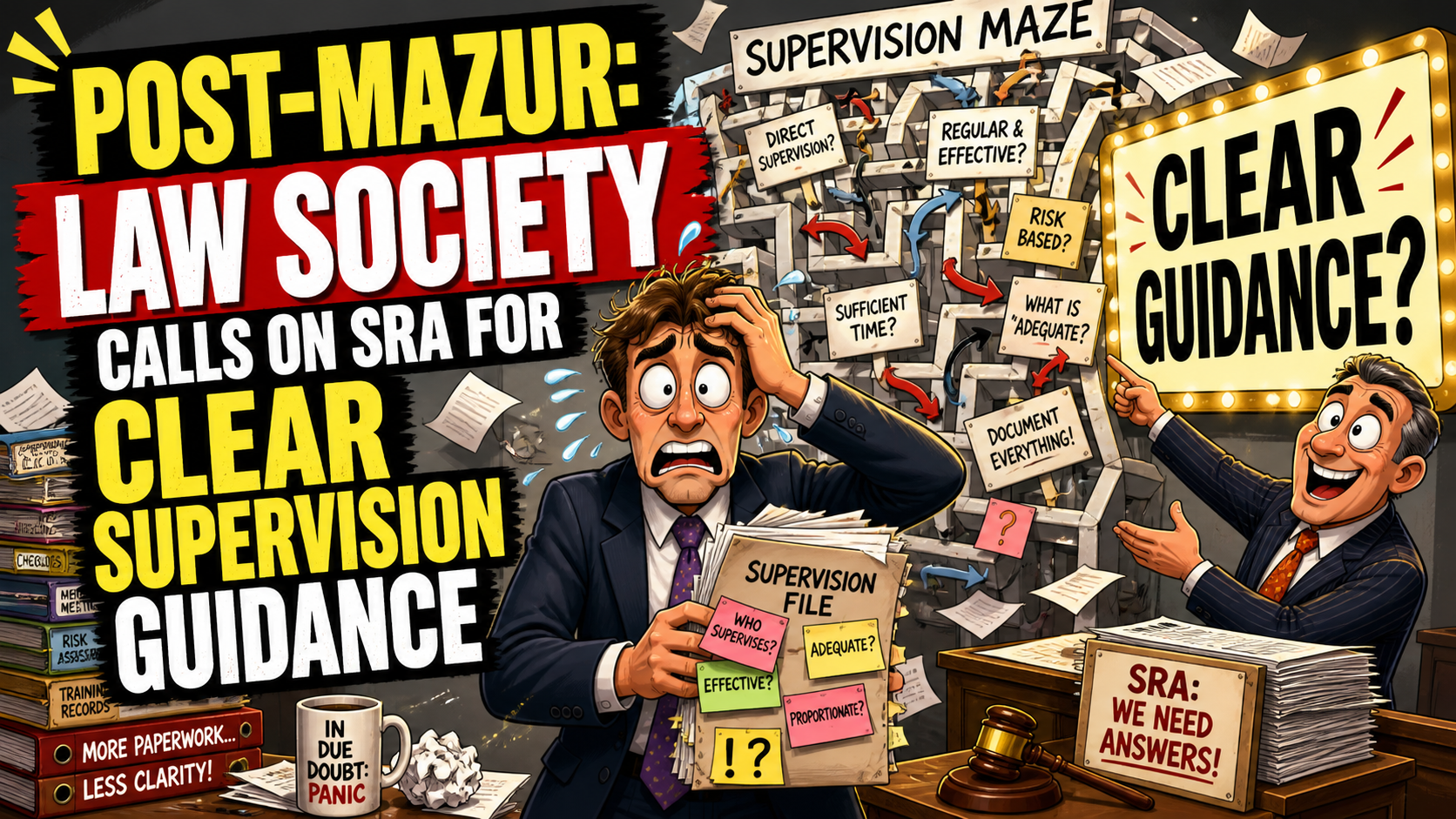
The Court of Appeal decision in CILEX v Mazur, handed down on 31 March 2026, concerns the role of non-authorised persons in the conduct of litigation.
Under the Legal Services Act 2007, the right to conduct litigation is a reserved legal activity, limited to authorised persons such as solicitors, barristers, CILEX practitioners and costs lawyers. Unauthorised individuals, such as paralegals and litigation assistants, cannot themselves “conduct litigation” within the meaning of the Act.
Following the High Court’s decision on Mazur back in September 2025, it was understood that supervision alone was insufficient to render the actions of a non-authorised person lawful if they were conducting litigation. However, the Court of Appeal confirmed that tasks falling within the scope of the conduct of litigation may be carried out by unauthorised persons, provided they act for and on behalf of an authorised individual who maintains responsibility and oversight.
As the Court of Appeal stated, an unauthorised person may perform such tasks where the authorised person maintains control, oversight and supervision. The effect is not to cross a legal boundary, but to confirm that litigation may be conducted through others, rather than strictly by the authorised individual alone. In response, The Law Society has issued a practice note (found here: Mazur and the conduct of litigation | The Law Society) and is calling on the Solicitors Regulation Authority to provide clearer, updated guidance on supervision.
The ‘grey area’ lies in what is considered sufficient supervision. The Court of Appeal acknowledged that this is context dependent. In some circumstances, close oversight and prior approval may be required, whereas routine work may justify a lower level of control and supervision.
In practical terms, adequate supervision is likely to require that the authorised lawyer:
· Understands the case and its procedural stage
· Retains control over key decisions, such as issuing proceedings
· Determines the issues to plead and contest
On the other hand, supervision is likely to be inadequate where the authorised person is merely nominally involved, for example, where they are unaware of filings or deadlines, do not make substantive decisions, or simply “rubber-stamp” work carried out by unauthorised persons.
The absence of a clearly defined threshold creates a risk of inconsistent interpretation and application. Firms may adopt differing views as to what constitutes appropriate supervision, leading to uneven compliance and potential regulatory uncertainty.
The decision in Mazur confirms that delegation is both permissible and, in modern practice, unavoidable. However, it leaves unresolved the critical question of where supervision ends and unauthorised conduct begins. The SRA’s existing guidance on supervision remains in place but is expected to be updated in light of this decision.
Without current, clearer guidance from the SRA, firms are left to navigate this boundary using general, case-specific principles. This not only increases the risk of inconsistent application, however, also places authorised individuals in a position where compliance may ultimately be judged retrospectively. Greater regulatory clarity is therefore essential to ensure both effective delegation and legal certainty in the conduct of litigation.
Author: Alla Abdalla
Leave a Reply