
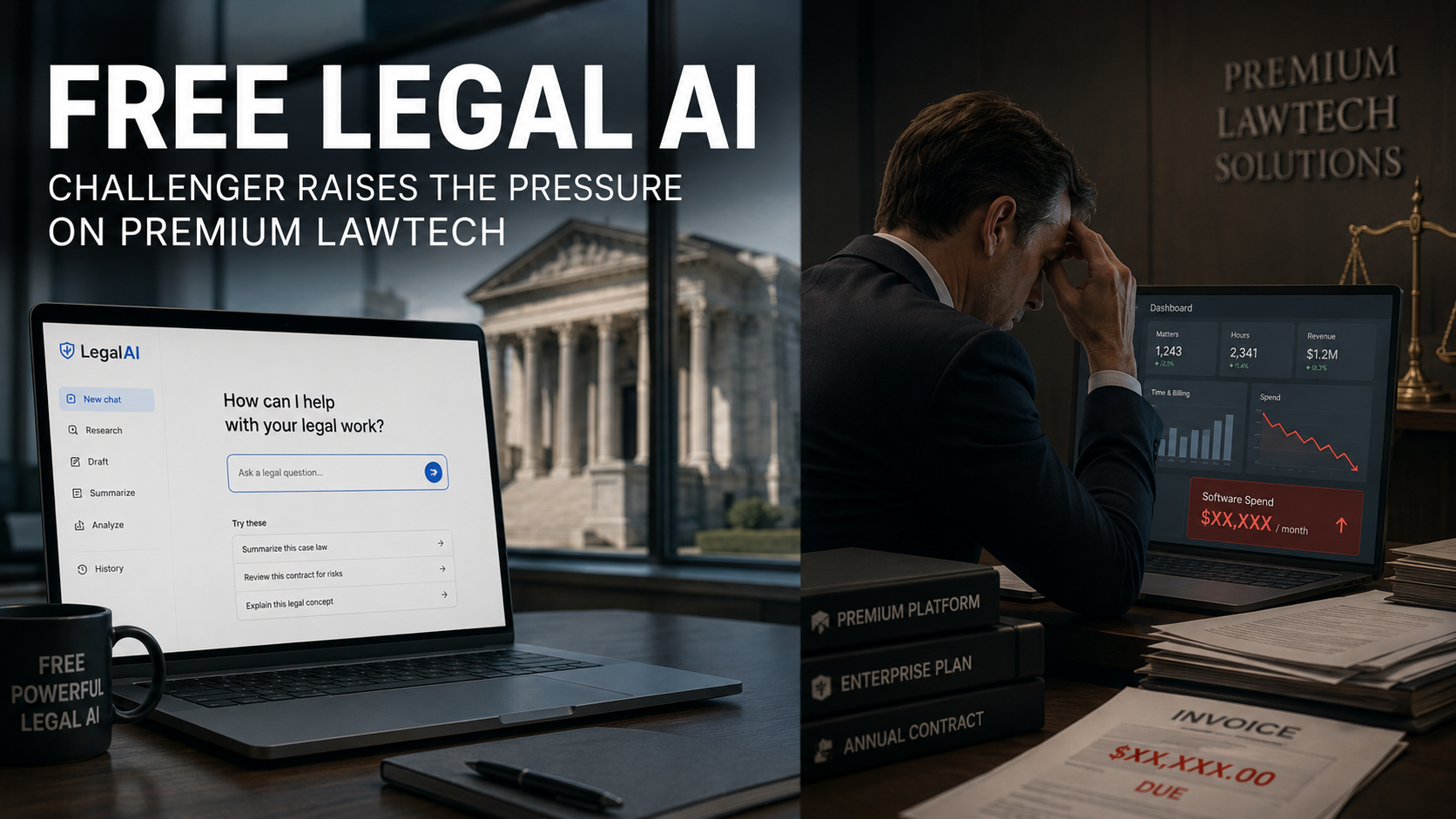
A former Latham associate has launched “Mike”, an open-source tool positioned against established legal AI products such as Harvey and Legora. Its most striking feature is also its simplest: it is free.
That alone does not upend the profession. Tools of this kind do not replace regulated legal advice. They operate earlier in the process—drafting, summarising, handling first-pass analysis. The risk does not disappear; it is merely relocated. Supervision becomes the critical point. Firms remain responsible for accuracy, for safeguarding client information, and for maintaining privilege. If a tool is involved, the firm still signs off on the result.
The pressure shows up elsewhere. Many practices have already committed substantial sums to commercial AI platforms, often integrated into wider systems and packaged as part of a premium service. A credible free alternative has a way of making those decisions look rather different in retrospect. Clients, for their part, are rarely interested in the machinery behind the curtain. Price, speed and reliability tend to concentrate the mind more effectively.
This in turn sharpens a more delicate question: what, exactly, is the client paying for? When a competent draft can appear in seconds, the emphasis shifts to the layers that follow—review, judgment, and the careful tailoring of advice to a client’s position. Those elements were always present, but they are now under brighter light. Firms that struggle to articulate the distinction may find the discussion moving in directions they would prefer to avoid.
Open-source tools bring their own complications. Security, data handling and ongoing support are less predictable than with established vendors. “Free” can prove expensive if it introduces confidentiality risks or produces errors that take longer to correct than to avoid. For some firms, that calculation will be enough to keep them within the orbit of paid platforms.
Others will take a more experimental approach. The barrier to entry is negligible, and the potential gains are difficult to overlook. Even without deploying such tools on client matters, there is scope for internal use—research, early-stage drafting, or simply reducing the administrative drag that accumulates across a working day. Incremental efficiencies, applied consistently, have a habit of becoming material.
The broader market is already adjusting. Legal AI is no longer a peripheral curiosity; it is edging closer to core infrastructure, shaping both how work is delivered and how it is priced. The arrival of a free contender accelerates that shift and, in doing so, prompts a rather direct question: what is the client actually buying?
The answer is unlikely to be “access to software”. More durable is the combination of judgment, experience and accountability. Those have always been the profession’s calling cards. What is changing is the cost and visibility of the routine work beneath them. It is becoming cheaper, faster—and harder to hide.
Leave a Reply