

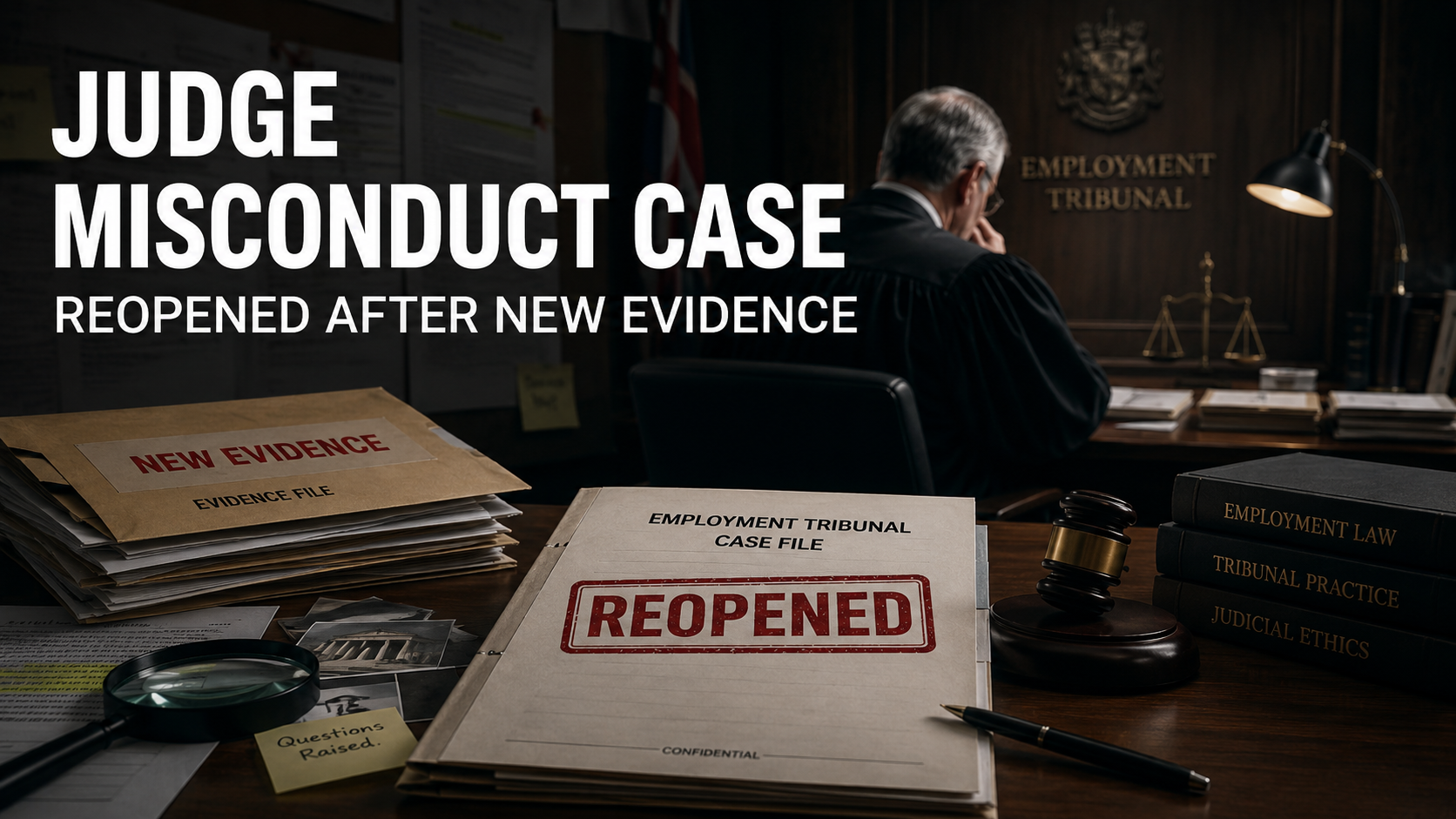
A complaint about a judge rarely merits much attention once it has been closed. This one has managed to return to the docket.
The Judicial Conduct Investigations Office has agreed to reopen allegations concerning Employment Judge Philip Lancaster following the emergence of new evidence. Details remain sparse for now, but the decision itself signals the weight given to fresh material. Cases may close, but they are not, it seems, beyond recall.
The conduct process sits alongside—rather than within—the appeal system. It addresses behaviour: how a judge conducts proceedings, not whether a decision was legally sound. That distinction is often blurred. Litigants who lose may feel a hearing was unfair, but dissatisfaction with the outcome is a matter for appeal. Conduct proceedings are concerned with something narrower, and in some ways more fundamental: whether the tribunal environment met the standards expected of it.
Allegations of bullying or intimidation go directly to that question. Tribunal hearings are hardly gentle affairs at the best of times. Many claimants appear without representation; employers may be handling disputes with implications for staff, reputation and cost. Introduce a tone that edges into hostility and the process becomes more difficult to navigate, whatever the merits of the case.
Reopening a complaint reflects a willingness to revisit earlier conclusions when evidence supports it. That is not merely procedural housekeeping; it goes to confidence in the system. A process that appears too eager to close ranks risks eroding trust. One that allows for correction, even at a late stage, at least preserves the possibility of it.
For employment lawyers, the practical impact is subtle but tangible. Advice to clients often turns on how hearings are likely to unfold in practice, not simply what the rules prescribe. Perceptions of judicial conduct—even at the margins—feed into those expectations and, in turn, into strategy.
There is also the perennial question of when and how to raise concerns. Challenging conduct in the moment can be delicate, particularly with a live case at stake. Recording objections for the record offers a degree of protection but carries its own risks. Leaving matters until after the hearing, via a formal complaint, is often no simpler. None of the routes is especially comfortable.
The JCIO is not an alternative forum for arguing the case again. Its remit is narrower, focused on conduct rather than outcome. Still, its findings can have real consequences—for the judge involved and for the broader perception of how tribunals operate.
From the outside, the process can appear opaque: a complaint is made, dismissed, then revived, all with limited public explanation. Those within the system will find the sequence less surprising. Processes built on written material depend, ultimately, on the evidence available. When that changes, so too can the conclusion.
The reopened case does not resolve the allegations; it merely puts them back in play. In a system where authority rests as much on conduct as on legal reasoning, that alone is a significant step.
Leave a Reply