

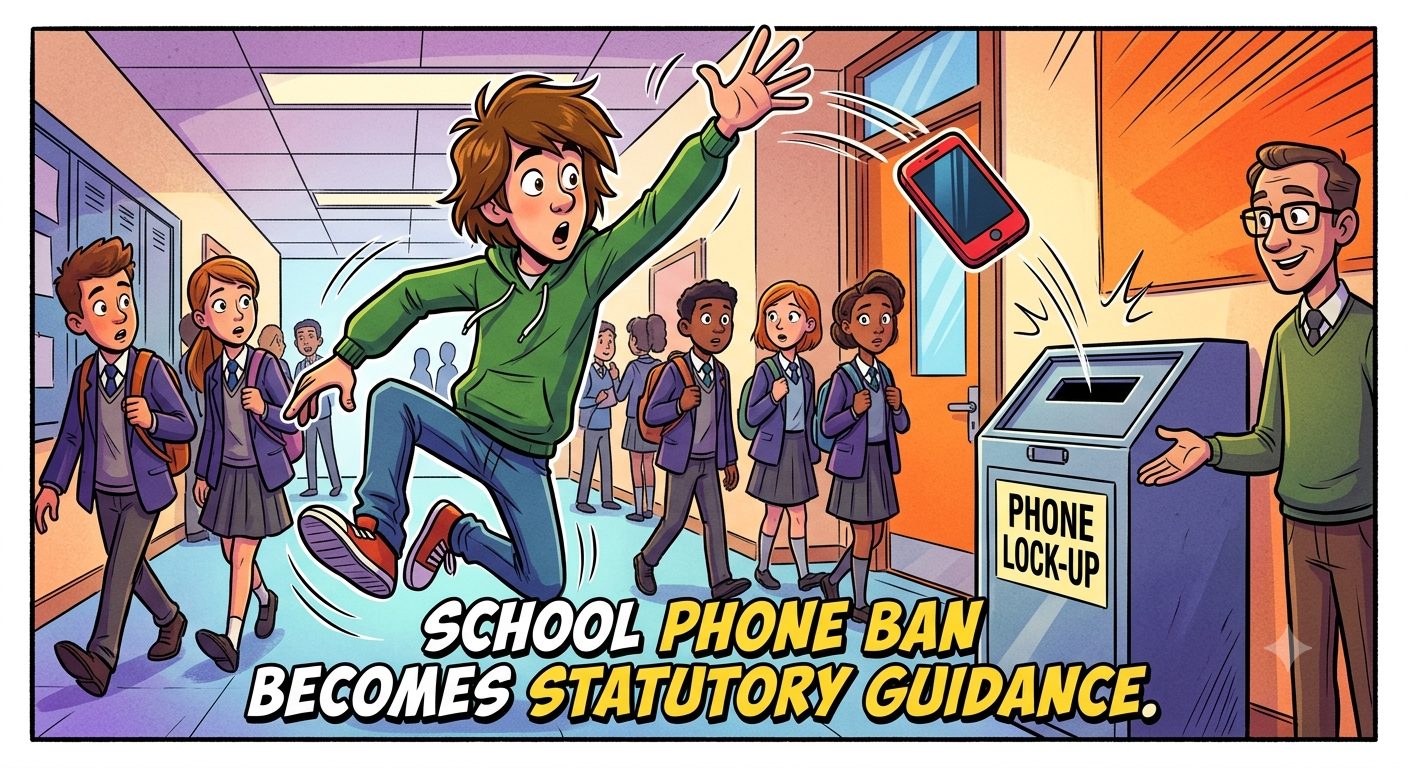
Updated Department for Education guidance became statutory on 29 June. Schools in England should begin following it from 1 September. The guidance says schools should be mobile phone-free by default and should prohibit the use of phones and similar smart technology throughout the school day, including lessons, breaktimes and lunchtime.
This is not a criminal ban on children owning phones. It is guidance for schools and trusts on behaviour policies. That distinction matters. Schools must still act within their legal duties, including safeguarding, equality duties and reasonable adjustments for disabled pupils. A blanket rule may look clean on a poster. Implementation rarely has poster handwriting.
The guidance covers communication with pupils and parents, staff roles, sanctions, searches, adaptations and reasonable adjustments. It also says references to mobile phones should include other communications and smart technology with similar functions. That catches the modern pocket zoo: smart watches, messaging devices and anything with notifications breeding quietly under a sleeve.
For education lawyers, the likely disputes are predictable. Parents will argue a pupil needs a device for medical monitoring, caring responsibilities, travel safety or disability-related support. Schools will argue consistency, behaviour and safeguarding. The law does not require schools to surrender to every parental anxiety. It does require them to consider individual circumstances where legal duties are engaged.
Searches will need particular care. School staff already have powers to search pupils in certain circumstances, but phone searches raise privacy and data issues quickly. A device may contain family messages, health information, images, location data and social media accounts. Confiscating a phone is one thing. Going through it is another country.
The policy also links to the wider under-16 online safety debate. Removing phones during the school day reduces access, distraction and some safeguarding risk. It does not solve platform design, addictive feeds, bullying outside school hours or parents who conduct family admin through WhatsApp like a small emergency government.
For schools, the commercial burden is operational rather than theoretical. They will need policies, staff training, parent communications, storage arrangements and sanctions that survive complaint. Trusts will want consistency across academies. Local authorities will field the spillover when exclusions, discrimination complaints or safeguarding disputes arise.
The guidance is clear enough to shift the baseline. The hard cases will test whether schools can be firm without being foolish.
A phone-free school day is simple to announce. The law lives in the exceptions.
The guidance also gives parents a role, which may be where the social policy becomes domestic warfare. Schools can ban phones in corridors. They cannot ban the expectation that a child should text at lunchtime, track the bus, or send a photograph of forgotten PE kit like evidence in a small claim. The school rule will need family buy-in, not just laminated firmness. It will also need consistency, because teenagers can smell loopholes through a locked drawer. So can parents, quickly too.
Author: Sophie Carrington
Leave a Reply