

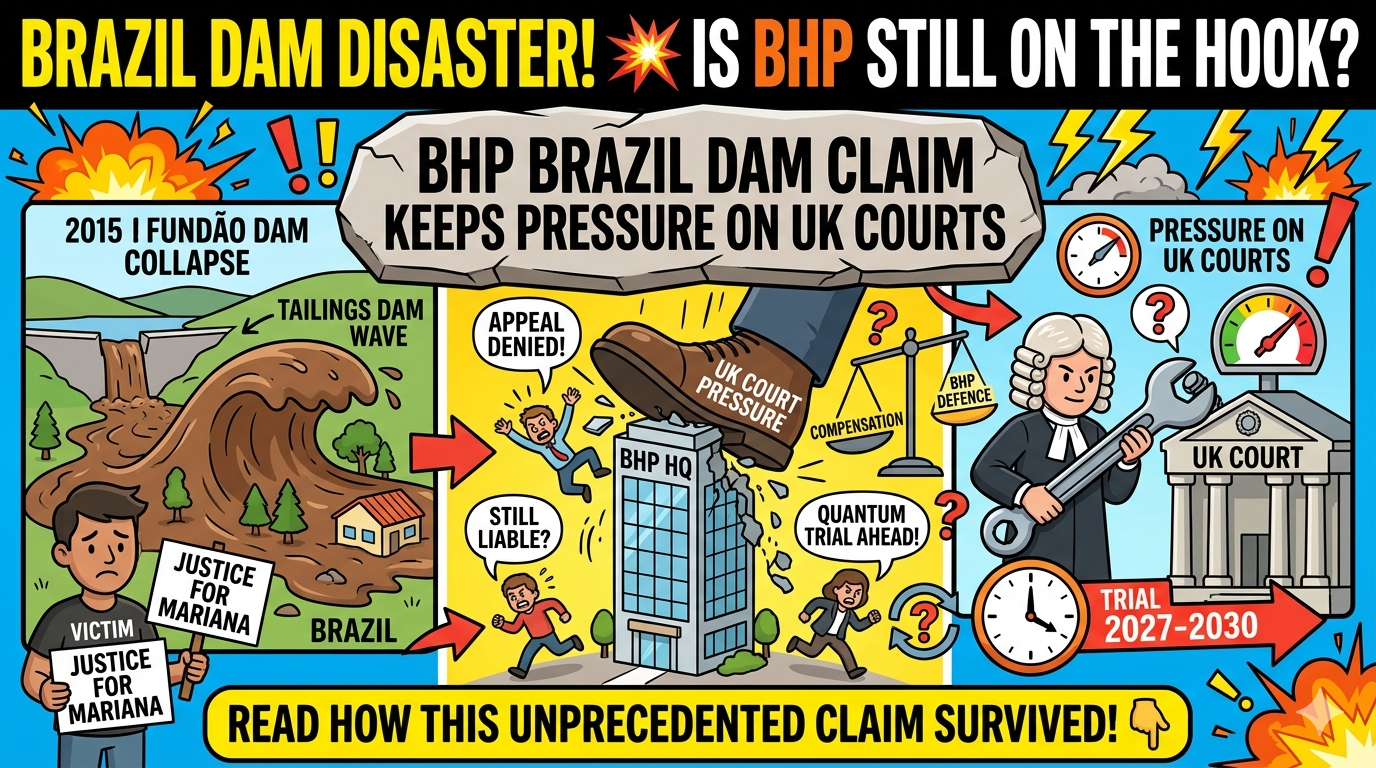
The Court of Appeal handed down judgment on 6 May in the litigation brought by Municipio de Mariana and many other claimants against BHP Group entities. The case arises from the Samarco dam collapse in Brazil, a disaster which killed people, damaged communities and caused vast environmental harm. The English proceedings have become a test of how far UK courts can manage international mass claims against multinational corporate groups.
Defendants in large cross-border litigation often fight hard over process before any trial of liability or loss. Jurisdiction, case management, admissibility, parallel proceedings and alleged abuse of process can decide whether a claim survives long enough to be heard on facts.
Group litigation is not one person suing over one wrong. It is a structure for many claimants whose cases share common issues dictated under Part 19 of the Civil Procedure Rules. English courts can manage these claims through lead issues, sample claims and staged trials. Those mechanics are vital when the number of claimants is huge and even more so when that is amplified by the evidence spanning across multiple countries, languages and legal systems.
Corporate defendants facing overseas harm claims in London are not only fighting damages. They are fighting jurisdiction risk. If English courts remain open to large environmental and human rights claims linked to UK parent companies or corporate structures, global businesses with UK connections must price that risk into insurance.
The claimants’ side will read the ruling as further support for using London to pursue large-scale accountability claims, the defendants will continue to stress the complexity of overlapping proceedings and the need for a fair process and both points are valid and are to be considered. Large group actions can deliver access to justice where local routes are limited, but they can also create hard questions about duplication, proof and whether a court can manage claims efficiently at scale.
The case is a reminder that environmental, social and governance risk is a litigation risk with arent company structures, supply chains, joint ventures and overseas operations all becoming evidence in English proceedings and for now, the Court of Appeal’s latest judgment keeps the case moving through English courts.
The ruling also strengthens London’s reputation as a forum willing to handle difficult claims rather than push them away because they are inconveniently large. That reputation cuts both ways. It attracts claimant work, but it also makes multinational groups more alive to litigation planning whenever UK entities sit in the corporate chain.
Author: TOF
Leave a Reply