

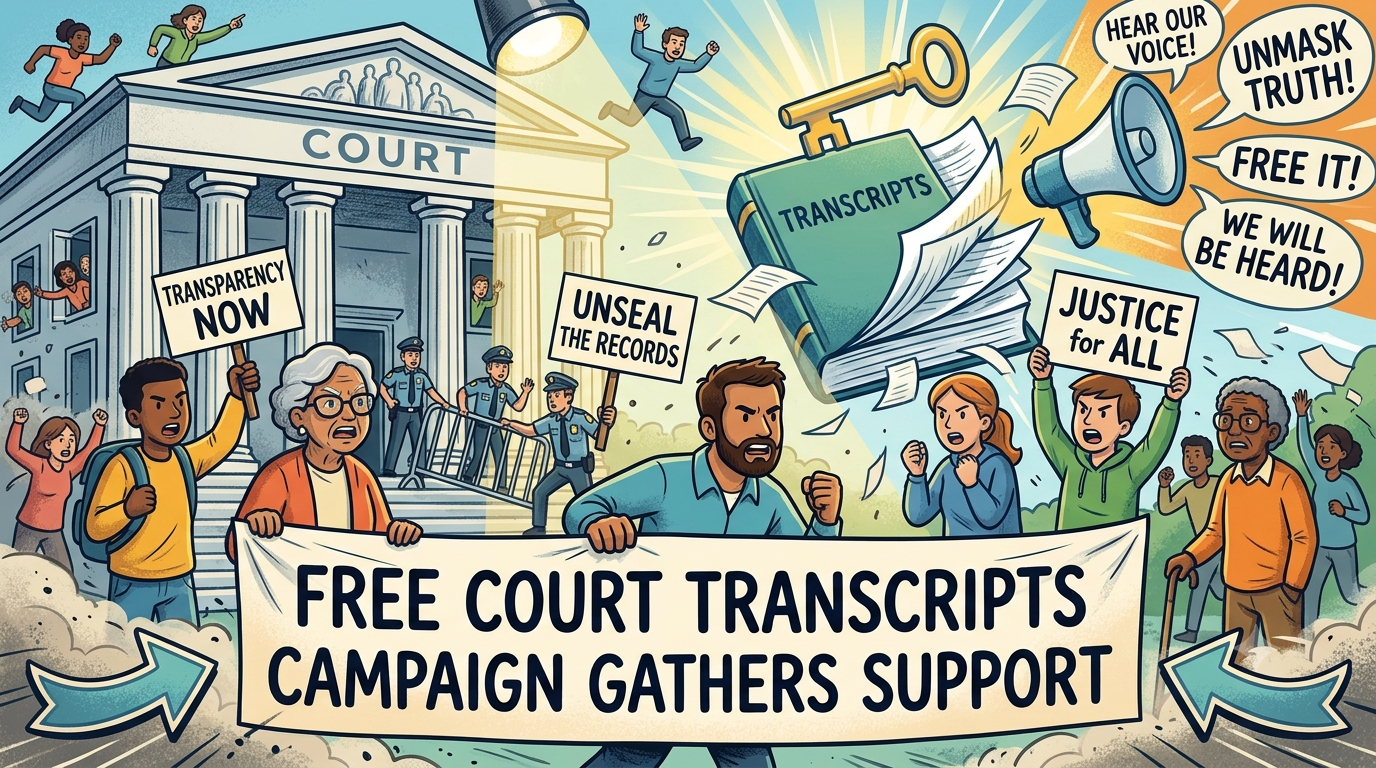
Open justice has discovered the ancient British art of saying “of course you may” while quietly reaching for the card machine.
A cross-party early day motion is calling for court transcripts to be made freely available. The idea is almost embarrassingly reasonable. Courts sit in public. Judges give reasons in public. The system tells us, with a straight face and a framed portrait nearby, that justice must be seen to be done.
Then someone asks to see what was actually said, and open justice produces an invoice.
A transcript is the written record of a hearing. It shows the words used by judges, lawyers and witnesses. That makes it more than legal stationery. It is the memory of the court. Without it, public justice becomes a live performance: available to those who were in the room, lost to everyone else, and remembered differently by all concerned.
Journalists need transcripts to report accurately. Campaigners need them to check power. Lawyers need them to advise, appeal and compare decisions. Litigants in person, people representing themselves without lawyers, need them because the court system already expects them to navigate a maze while holding a candle in a draught.
The current system makes sense only if justice is treated as a place, not a record. Yes, you can sit in a courtroom. Splendid. That helps if you are nearby, free at 10.30am on a Tuesday, able to follow fast argument, and not at work, caring for someone, disabled, broke, anxious, or locked out by the ordinary inconvenience of life.
Most people cannot audit the justice system by loitering politely in Court 7.
Written reasons and transcripts turn a passing moment into something that can be checked. They let people see whether a point was argued, conceded, ignored or misunderstood. They show whether fairness was actually done, rather than merely announced in the confident tone courts use when the furniture is heavy.
Cost is the obvious objection. Transcription involves labour, technology, storage, redaction and management. Courts are not exactly lounging about on golden cushions wondering what to spend money on next. The justice system is short of almost everything except acronyms and queueing.
But access costs are not neutral. A wealthy party can buy the record. A poor party may have to rely on notes, memory, or a short judgment which tells them the result but not the road taken to get there. That difference can shape appeals, complaints, media coverage and public trust. A right that works only when you can afford the paperwork is not much of a right. It is customer service for the solvent.
There is a media law problem too. Bad reporting grows well in the dark. If official transcripts are expensive, slow or difficult to obtain, rumour and partial accounts move in like damp. Free access would not make every report fair or clever. Nothing can perform miracles on a deadline. It would make the accurate version easier to find than the confident wrong one.
The judiciary has already shown more interest in publishing sentencing remarks in serious criminal cases. That is useful. It is also only part of the building. Civil, family, tribunal and administrative hearings can decide homes, jobs, children, liberty, immigration status, money and reputation. These are not minor civic errands. They are life events with legal captions.
Family courts are the difficult corner, and pretending otherwise helps nobody. Privacy, children and safeguarding often justify limits on public access. That does not defeat the case for better transcript access. It means the system needs redaction, controlled release and rules which people can understand before they need them.
The hard bit is building something that protects privacy, respects reporting restrictions and funds the work properly. Nobody should pretend that is easy.
Nobody should pretend the present arrangement is dignified either.
Justice speaks in public. The public should not need an invoice to hear it again.
Author: Marcello Williams
Leave a Reply