

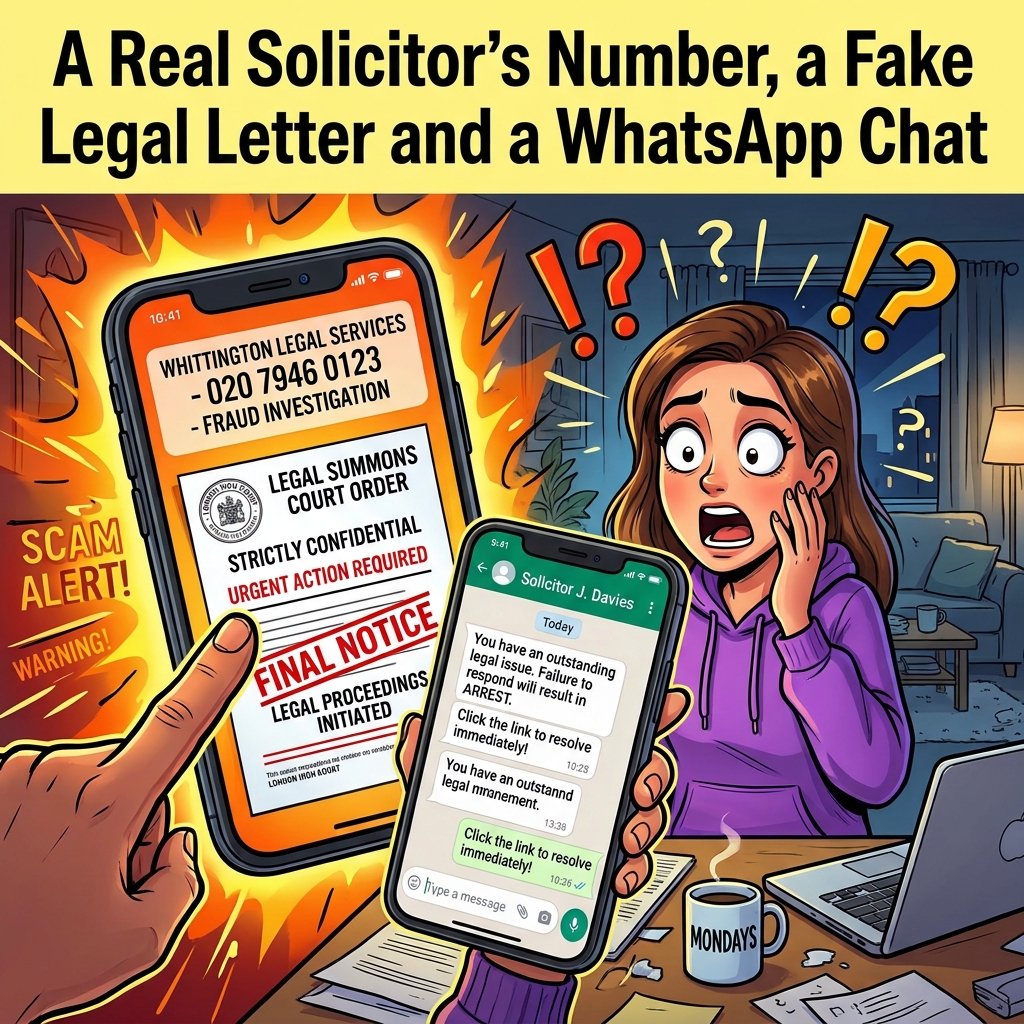
Primary source(s): SRA scam alert, sra.org.uk, 26 October 2026 (“Document misusing the SRA number of Jamie Dean Jones”).
Background: The Solicitors Regulation Authority has warned that a document sent to a member of the public quoted the SRA number of a genuine solicitor, Jamie Dean Jones of Stone Rowe Brewer LLP, offered to draft a legal letter and asked the recipient to send files via a WhatsApp number. The SRA understands the person had contacted a freelancer through a third-party website. Mr Jones and his firm have confirmed they have no connection to the document or the number.
Every con needs a costume. It used to be a borrowed uniform or a clipboard. These days it is an SRA number, a short string of digits anyone can look up in half a minute, printed neatly at the foot of a document that would very much like you to send your passport over WhatsApp.
The Solicitors Regulation Authority has issued a fresh warning about exactly that. A member of the public received a document offering to draft a legal letter. It quoted the registration number of a real solicitor, Jamie Dean Jones of Stone Rowe Brewer LLP, then pointed the recipient to a WhatsApp number for sending over their files.
The real Mr Jones had nothing to do with it, and nor did his firm. Both have told the regulator so. That is worth saying twice: the named solicitor is the victim here, not the suspect. Someone has borrowed his professional identity because it makes a stranger look respectable.
According to the SRA, the person had found this “service” through a freelance website, not by contacting a law firm. That detail tells the whole story in miniature. People shopping for cheap legal help online are often frightened, short of money and in a hurry. A tidy PDF with an official-looking number feels like a solicitor. It isn’t one.
An SRA number proves a solicitor exists. It doesn’t prove that solicitor sent you anything.
What is an SRA number for? It is a public reference that lets you check, on the regulator’s register, that a solicitor or firm is authorised. Think of it as a car’s number plate. Handy for checking. Easy to copy onto a different car.
The risk is not only money. Anyone who sends case papers, bank statements and ID to an unregulated stranger has handed over the raw ingredients for identity fraud. There is no duty of confidentiality, no indemnity insurance and no compensation fund standing behind a WhatsApp account.
The SRA’s advice is simple and worth following. Do not use contact details supplied by the person you are trying to check. Look the firm up yourself on the Solicitors Register, find its number independently, ring it, and ask whether the named solicitor is really handling your matter.
Law firms have homework too. Clients increasingly arrive through search engines and marketplaces, so it helps to tell them early which channels the firm will and won’t use, and to welcome the client who calls to check. That call is not rude. It is what a sensible person does.
The register exists so the public can trust lawyers. Fraudsters have noticed it also helps them impersonate one. The fix isn’t to hide the register. It is to use it properly, through a door the scammer didn’t open for you.
Author: Marcelo Williams
Leave a Reply