

Check out the primary source: Here!
Governments love announcing tough reforms. They are much quieter when they drop them.
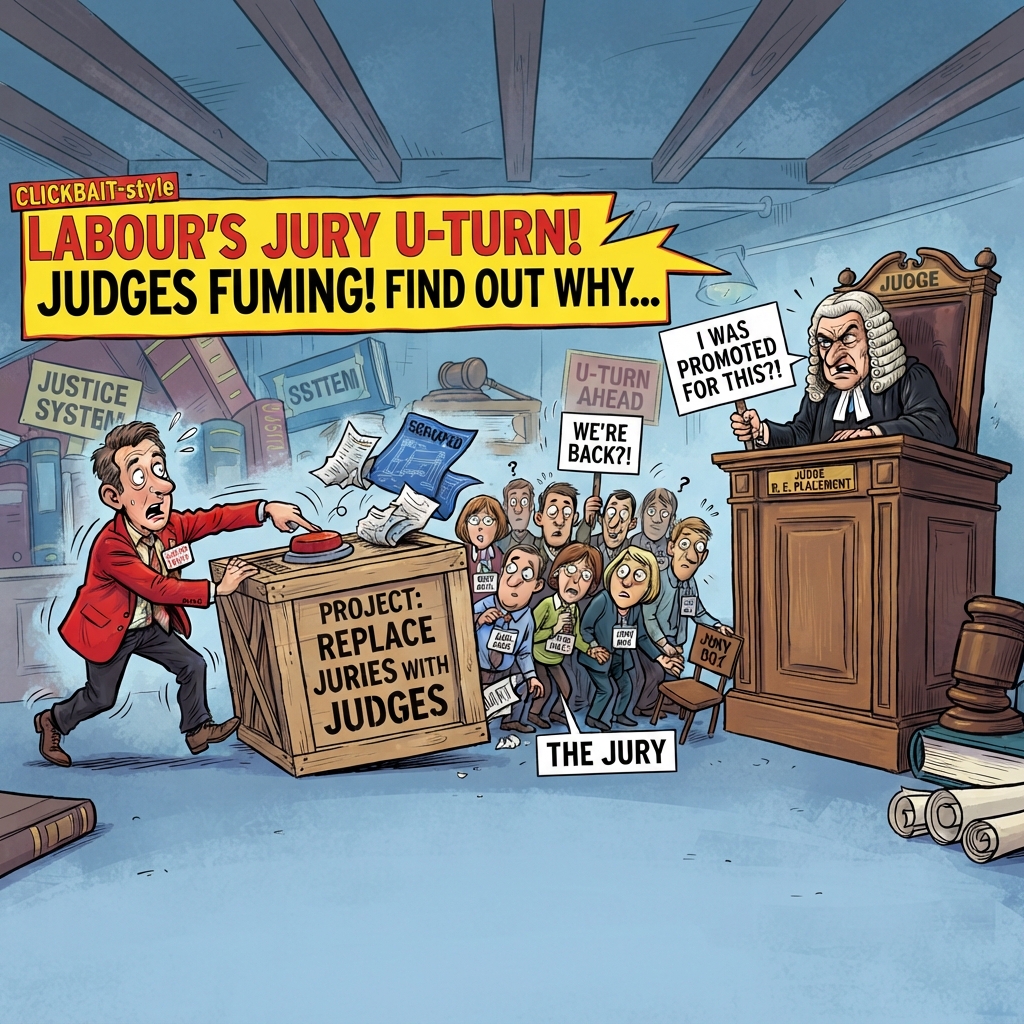
The Ministry of Justice has confirmed a significant U-turn on plans to curb jury trials in England and Wales. The original plan, drawn up under former justice secretary David Lammy, would have created a new “Crown Court Bench Division” where a judge sitting alone, not a jury, decided cases likely to end in a sentence of three years or less. That idea has now been scrapped. In its place, only certain fraud and financial offences will be tried without a jury, a far narrower carve-out than Lammy ever proposed.
The announcement came from Alex Norris, sworn in as Lord Chancellor on the first day of the legal year, succeeding Lammy after Keir Starmer’s resignation brought Andy Burnham into Downing Street over the summer. Norris said he had “heard the strength of feeling” on the reforms and decided to “change course,” while insisting he remains committed to clearing a Crown Court backlog that stood at 80,829 outstanding cases at the end of June and keeps climbing. He made the announcement on the first day of the Conservative Party conference, timing nobody in Westminster will have missed.
Not everything survives. Norris is keeping the other, less-discussed half of Lammy’s plan: removing a defendant’s automatic right to choose a Crown Court jury trial over a magistrates’ hearing for “either-way” offences, the kind that cover theft and burglary. Courts, rather than defendants, will decide where those cases are heard. Campaigners who fought hardest against judge-only trials for serious matters may still find themselves arguing about jury rights for the less serious ones.
For anyone new to why this fight mattered: a jury trial means twelve members of the public decide guilt, not a single judge. Supporters of the reform argued juries take longer to empanel and manage, and that fewer jury trials would move cases faster through an overloaded system. Opponents, including dozens of Labour’s own backbenchers, argued that removing a fundamental safeguard to solve an administrative backlog got the trade-off badly wrong.
Karl Turner, the Hull East MP who led the parliamentary rebellion against Lammy’s plan, was quick to claim victory, telling reporters he had “engaged directly with the Justice Secretary and his political advisers in recent weeks” and found the discussions “constructive and encouraging.” The Courts and Tribunals Bill returns to the Commons on 13 October carrying a new statutory commitment: an independent review of how these structural reforms affect people from ethnic minorities and other different backgrounds, before it heads to the Lords for further scrutiny.
Norris’s appointment is itself a small piece of constitutional history: he is the first non-lawyer to hold the office of Lord Chancellor under a Labour government, a fact made sharper by the Constitutional Reform Act 2005, which modernised the role and was steered through Parliament by a Labour Lord Chancellor who was himself a lawyer, Lord Falconer. The Lady Chief Justice, Baroness Carr, used his swearing-in to remind him publicly of the office’s “statutory duty to defend judicial independence,” a line that reads differently now he has rewritten his predecessor’s flagship bill within days of taking the oath.
Lammy spent a year defending a policy nobody in his own party much liked. His successor dropped most of it within ten weeks of being sworn in.
Author: Stacy Gomez
Leave a Reply