


The High Court has ruled that the Solicitors Regulation Authority cannot force a law firm to hand over material protected by legal professional privilege (“LPP”) unless the client agrees or Parliament has expressly said otherwise. LPP is the rule that keeps what you tell your lawyer between you and your lawyer. It is the first time a court has settled this question, and it lands as a serious blow to how the profession’s own regulator investigates its members.
The case pitted Carter-Ruck, the London media law firm known for representing high-profile clients, and its client Mohamed Amersi, a businessman and political donor, against the SRA. The regulator opened an investigation into Carter-Ruck in 2023, shortly after Amersi’s libel claim against former Conservative MP Charlotte Leslie was struck out. Leslie then complained to the SRA that the firm had run abusive litigation on Amersi’s behalf. To investigate, the SRA issued production notices under section 44B of the Solicitors Act 1974, a power that lets it demand documents from firms it regulates, and asked Carter-Ruck to hand over material relating to its work for Amersi.
There was a catch. Some of that material was privileged, and Amersi did not want to waive it. Carter-Ruck and Amersi argued the SRA had no power to see it regardless. The SRA argued it did, and that it needed access to investigate misconduct properly, sometimes even to clear a solicitor’s name. A three-day trial in July produced a judgment that firmly favours the client.
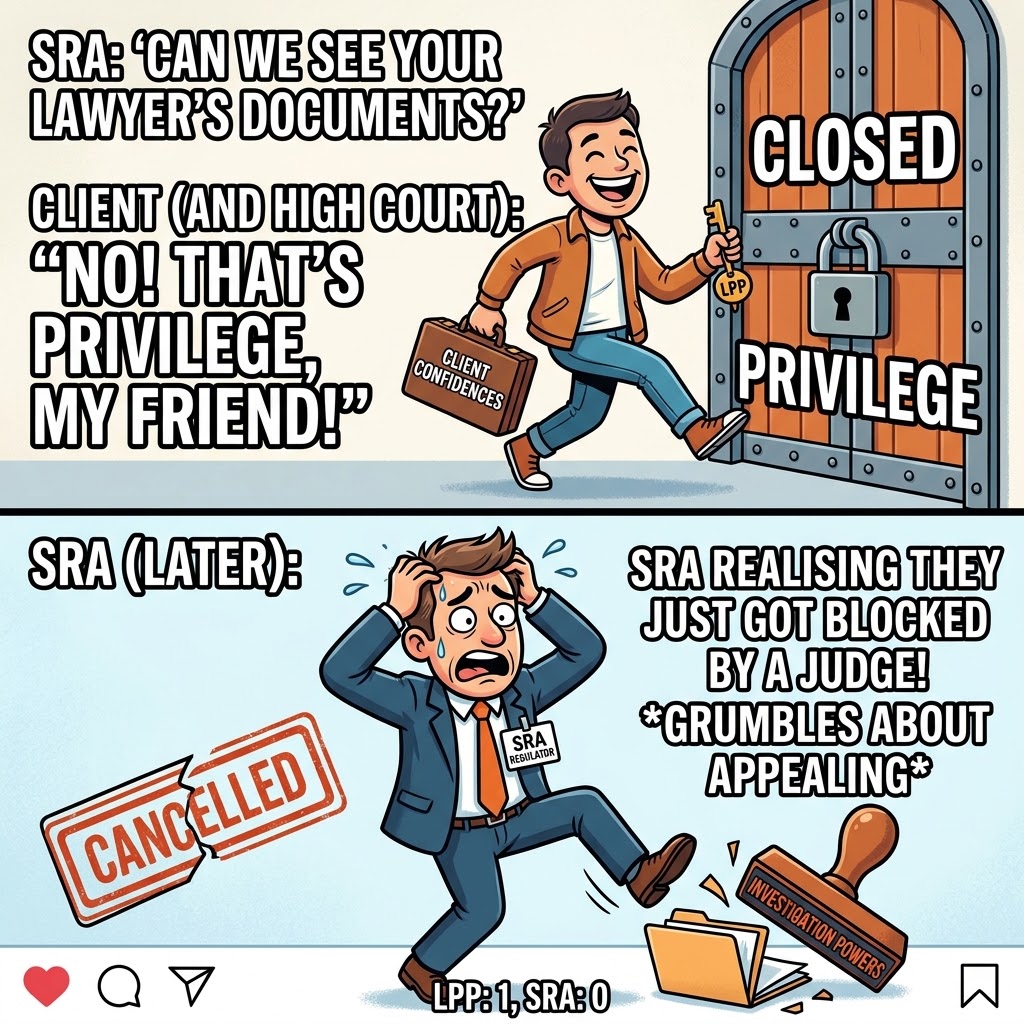
The point of privilege is not technical fussiness. It exists so people can speak candidly to their lawyers without fear that a regulator, a rival litigant or the police can later read it back to them. The SRA argued that its own statutory purpose, protecting the public from bad lawyers, should override that, at least for its own investigations. The court disagreed, finding nothing in the 1974 Act or later legislation that clearly hands the SRA that power.
Amersi called it a landmark ruling, comparing privileged legal advice to a patient’s medical records. His lawyers at BCL Solicitors put it more simply: “LPP is a fundamental right of every client.”
The SRA is not taking it well. In a statement, executive director Jonathan Peddie said the regulator “respectfully disagree[s] with the court’s decision” and confirmed it is seeking permission to appeal. In the meantime, it is working out what the ruling means for cases already under way, including investigations where privileged material may already have shaped its thinking, or where a firm has been resisting disclosure on exactly these grounds.
That matters, because the SRA has used section 44B this way for many years without legal challenge, on its own admission. If the ruling stands, the regulator’s ability to investigate third-party complaints against lawyers gets considerably harder, right as campaigners are pushing for tougher scrutiny of exactly that kind of lawyering.
Privilege just got a court ruling behind it. The SRA got a headache.
Author: Stacy Gomez
Leave a Reply