

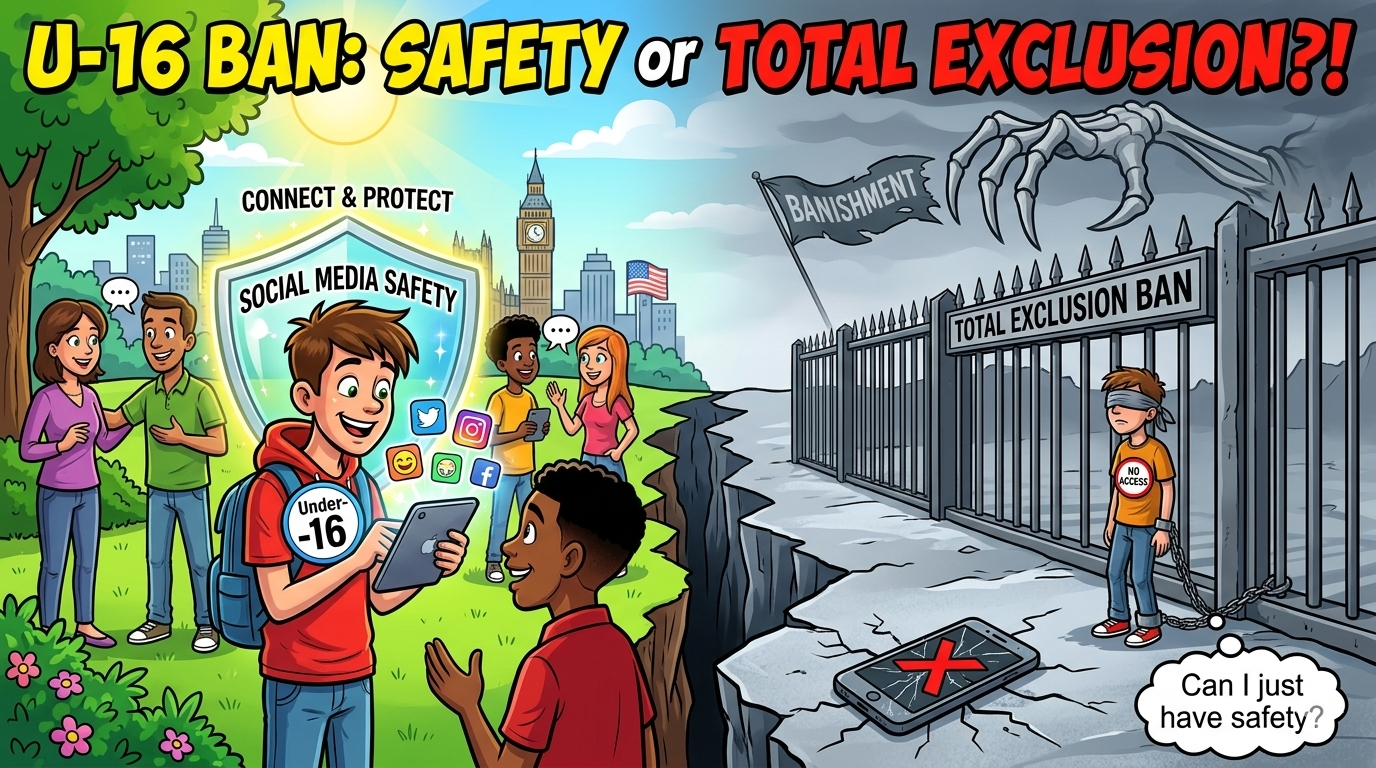
The government has decided that nudging users with better settings is no longer doing the job.
Ministers plan to ban social media platforms from offering services to under‑16s, with draft regulations expected before Christmas and the regime intended to take effect in spring 2027. The target is familiar: services built around user interaction, posting and algorithmic feeds. TikTok, Instagram, Snapchat, Facebook, X and YouTube are plainly in scope. Messaging services such as WhatsApp are, for now, expected to stay outside it.
Legally, this shifts the centre of gravity. The Online Safety Act focused on managing risk—removing illegal content, protecting children, and improving system design. The new proposal goes further. It treats access itself as the problem, or at least as something easier to regulate than the endless task of content moderation.
That hands Ofcom a larger role. The regulator is being asked to develop the approach to age assurance, enforcement and day‑to‑day operation. Age assurance covers everything from document checks and digital ID to facial age estimation. None is especially smooth. All raise awkward questions about privacy, data use and fairness. Children will look for workarounds. Platforms will look for design choices that pass muster. Lawyers will have a steady supply of instructions from both.
Enforcement is meant to sit with platforms, not children. Sensibly so. Fining teenagers for lying about their age would produce more ridicule than compliance. The harder issue is what counts as “reasonable” prevention. If weak checks let under‑16s in, is that a breach or simply the internet behaving in character? Ofcom will be asked to draw that line.
The parallel proposals on gaming and livestreaming complicate matters further. Under‑16s may be blocked from stranger contact and livestreaming features on other services, with default restrictions also envisaged for 16- and 17-year-olds. Boundaries between social media, gaming, news, education, music and messaging will start to matter commercially. The next year will be spent arguing about definitions, functions and exemptions. Dry work, but it will decide which products keep their user base.
Campaigners will welcome the clarity of a bright line. Technology companies will point out that younger users rarely disappear; they migrate. Both are right. Restrictions on mainstream platforms may reduce exposure there while pushing activity into less visible corners.
The policy is bold. Whether it works will depend on less exciting details: how enforcement is designed, what evidence of age checks is accepted, and whether children treat the system as a rule or a challenge.
Much turns on the consultation response due in July. It needs to define the services in scope, set out exemptions and show how the new regime sits alongside the Online Safety Act. Too broad, and it captures useful tools. Too narrow, and it leaves the same design under a different label. Drafting something clear enough for children, parents and product teams is harder than it sounds, which may explain why slogans have had an easier run than legislation.
Author: TOF
Leave a Reply