

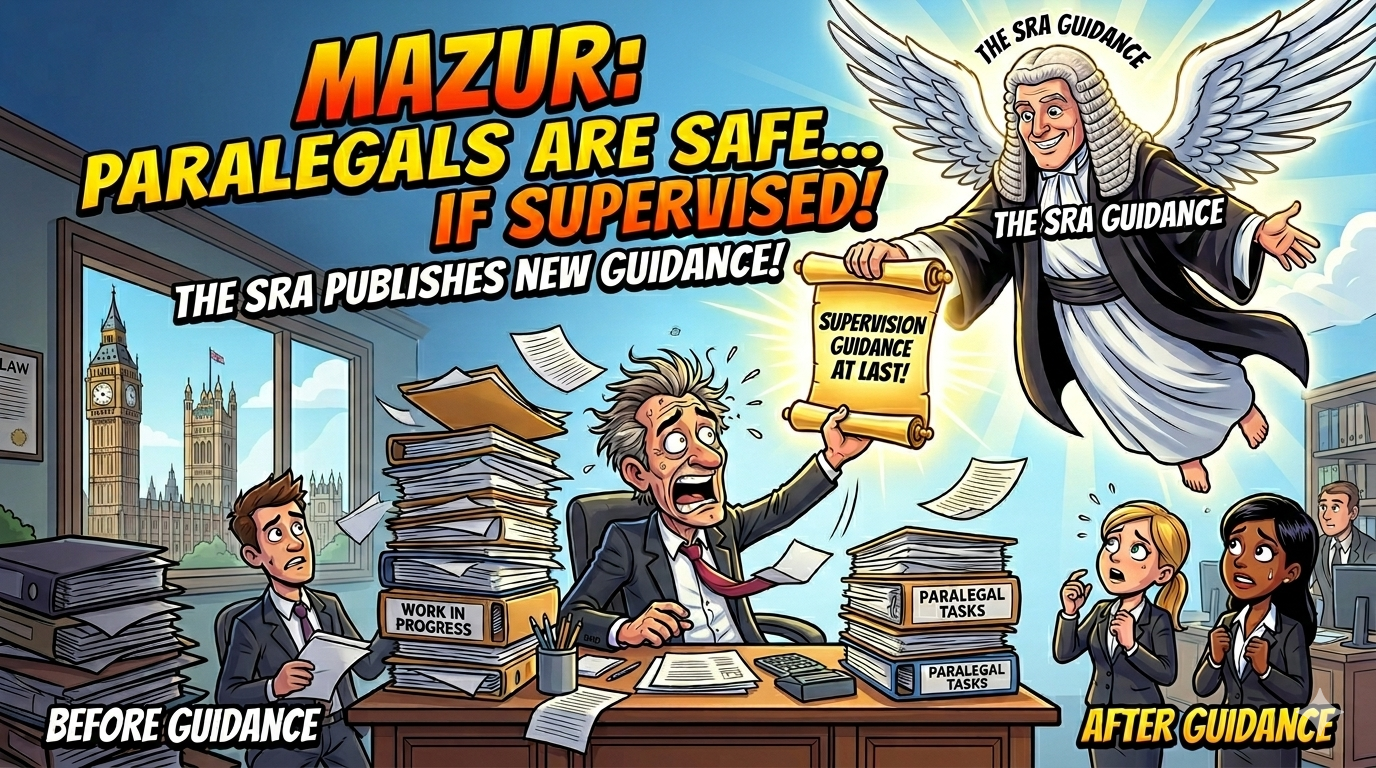
The SRA has rewritten its supervision guidance after the Court of Appeal restored the orthodox view: unauthorised staff can carry out litigation work, provided it is properly supervised. The revised material accepts that paralegals, trainees and other non-authorised staff may undertake tasks that fall within the conduct of litigation, as long as an authorised person retains responsibility and exercises real direction, supervision and control.
That clarification matters. The High Court’s earlier approach in Mazur triggered a compliance jolt. Firms with standard litigation teams—solicitors, legal executives, trainees and paralegals—were suddenly forced to wonder whether routine delegation had strayed into reserved activity. The Court of Appeal pulled the profession back from the edge. The SRA has now attempted to mark the boundary more clearly.
The guidance is longer and more prescriptive. It abandons the comforting fiction that unauthorised staff simply hover at the margins. They can do substantive litigation work. The authorised lawyer, however, must own the file, understand what is being done, and calibrate supervision to risk. A solicitor with a full caseload, glancing over the work of ten paralegals every few months, is not supervising. It is curating a future problem.
The impact will be most obvious in the claims sector. High‑volume litigation runs on delegation. Motor finance, housing disrepair, flight delay, data breach and mis‑selling practices all depend on non-authorised staff progressing large numbers of files. The SRA has also linked its guidance to claims management activity, where firms may rely on exemptions from FCA authorisation. The hint is not subtle. Delegation is lawful; turning solicitors into ornamental signatories is not.
Clients have a stake in this as well. Delegation can reduce cost and speed things up. It can also diffuse responsibility if no one senior is genuinely engaged. The distinction is not about job titles. It is about whether the authorised lawyer knows what is happening before an error becomes a court document.
For managers, the practical work is straightforward and unglamorous: map roles, document supervision lines, set escalation triggers, and check whether file reviews reflect actual risk. The Court of Appeal preserved the model. The SRA now expects it to be evidenced.
Mazur did not end delegation. It ended the idea that supervision can be assumed.
The awkward point, as ever, is accountability. Junior caseworkers may know the detail better than the supervising solicitor. Clients may deal almost entirely with paralegals. Documents filed in court may be drafted nowhere near a partner’s desk. None of this is unlawful if the system is controlled. It becomes a problem when the authorised person cannot explain the judgments made in their name. After Mazur, supervision is a management discipline, not a title. Firms that treat the guidance as a green light on staffing while neglecting audit trails have, in a quiet way, missed it.
Author: TOF
Leave a Reply