

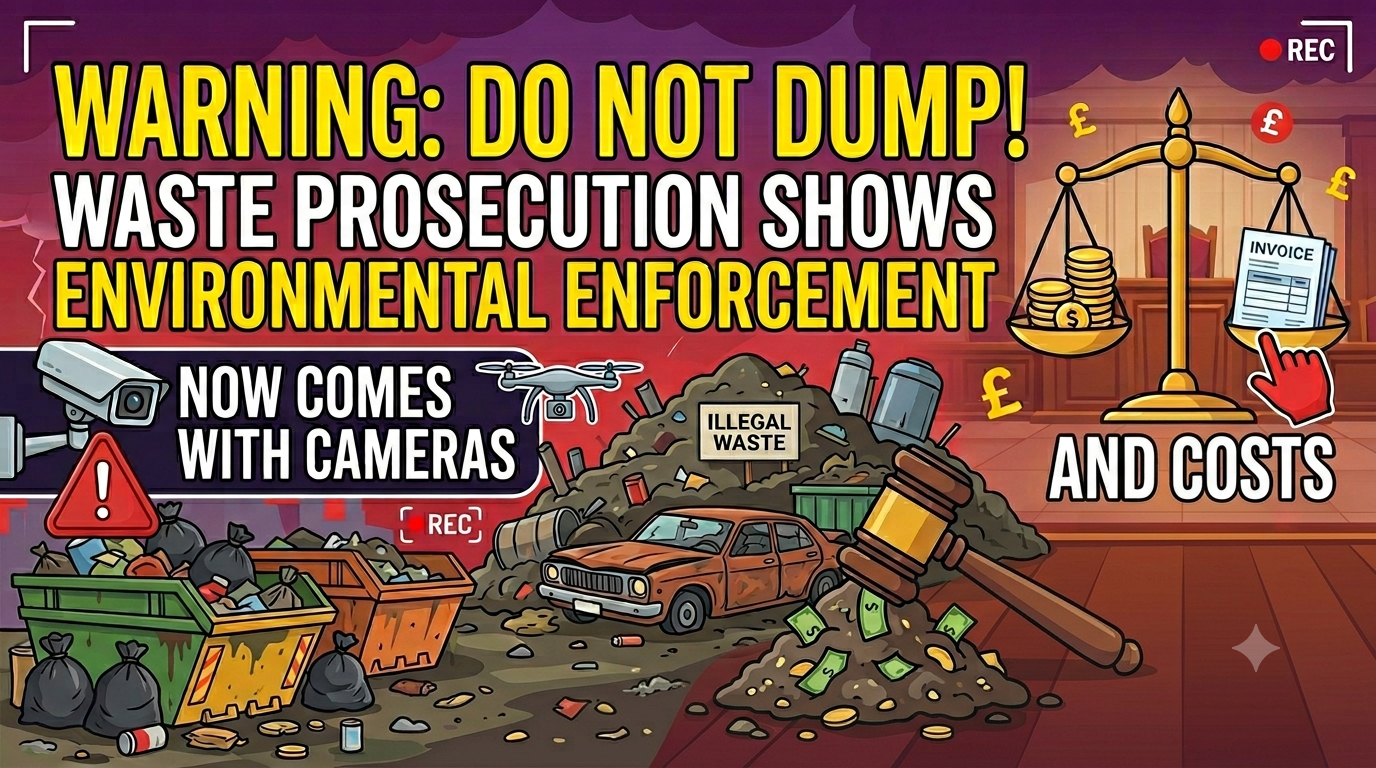
Fly-tipping has outgrown its reputation as a minor nuisance politely ignored at the margins.
The Environment Agency reported in early June that two individuals were fined and ordered to pay costs after waste was dumped in a Norfolk village. Surveillance cameras and drone footage tied vehicles to multiple sites in Clenchwarton. Rebecca Simper was fined £200 and ordered to pay £1,701.08 in costs and a victim surcharge after admitting ownership of a vehicle used in the dumping and failing to respond to notices requiring her to identify the driver. Luke Webb received a £200 fine, £850 in costs and an £80 surcharge after his truck was captured on camera and he, too, failed to engage with official requests for information.
On their own, the fines may appear modest. The legal framework, however, carries more weight than the headline figures suggest. Environmental enforcement often hinges on vehicle identification, surveillance evidence and statutory notices. Ignoring a requirement to identify a driver is not an administrative oversight; it becomes a separate route to liability. The law is structured to prevent ownership being treated as a convenient distance from responsibility.
For businesses, the message is familiar but too often neglected. Waste obligations do not end once material leaves the premises. Those arranging disposal are expected to know who is collecting it, where it is headed and whether the carrier is authorised. “Someone else dealt with it” is unlikely to satisfy a regulator. Illegal disposal exposes firms to prosecution, clean-up liability, reputational damage and, occasionally, uncomfortable conversations with insurers.
For local communities, the impact is more immediate. Dumped waste alters the look and feel of an area with surprising speed. Lanes, farmland and verges take on the appearance of neglect; wildlife is affected; land may be contaminated; and the cost of removal falls to councils or landowners. Repeated incidents tend to be read as something broader-a sign that basic order has thinned at the edges.
Enforcement, meanwhile, is becoming more methodical. The use of cameras and drones reflects a shift toward evidence-led investigation. Waste crime has traditionally relied on anonymity and speed. Both are less reliable when movements are recorded and vehicles identified. For prosecutors, such material has the advantage of clarity, cutting through the familiar uncertainty about who was present and when.
There is a broader question about deterrence. While costs and surcharges increase the financial impact, a £200 fine may not trouble operators who regard illegal disposal as a profitable shortcut. The more effective pressure may come from sustained enforcement-targeting vehicles, repeat behaviour and businesses for whom paperwork is seen as optional rather than essential.
Environmental law often carries the air of a specialist discipline. In practice, it is rather direct: it determines who bears the cost when waste is abandoned rather than managed.
The camera, increasingly, will identify the vehicle. The court will then decide whether the explanation that follows is equal to the evidence already in view.
For advisers, the underlying task remains unremarkable but necessary. Records must be clear, responsibilities documented and processes understood before they are tested. When scrutiny arrives-as it tends to-the file will be expected to explain who knew what, and when. That expectation is rarely negotiable.
Author: TOF
Leave a Reply