

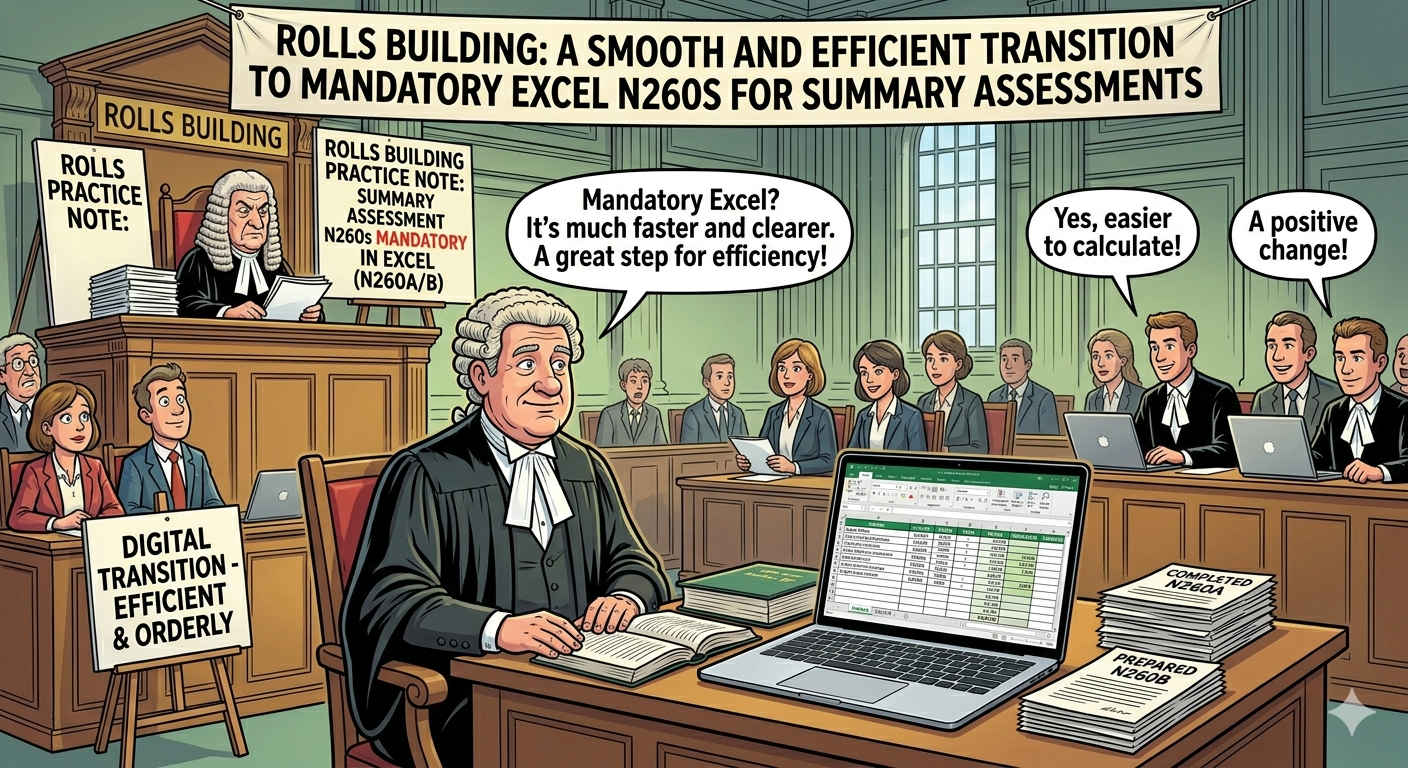
Recent changes have been introduced to the filing of N260 forms under the Rolls Building Practice Note.
As of 14 April 2026, changes to the Rolls Building Practice Note require parties appearing in the Chancery Division, Technology and Construction Court, Commercial Court and London Circuit Commercial Court within the Rolls Building to follow a revised procedure for filing N260 forms.
The N260 form is a Statement of Costs primarily used in summary assessments, a process whereby the court determines the amount of costs a party is ordered to pay following a hearing or trial lasting one day or less. Prior to 14 April 2026, these forms were commonly filed in PDF format only. Under the new Practice Note, parties are now required to file an Excel version of the N260 alongside the signed PDF version.
The Excel template can be accessed here: Excel-Template-N260-Clean-1-4-26.xlsx
Presenting figures in Excel format allows information to be displayed in a clearer, more structured and accessible way, making costs schedules easier to analyse and compare. The change is intended to improve the efficiency of summary assessment hearings by enabling judges to scrutinise costs schedules more quickly and consistently.
The introduction of a standardised spreadsheet format also promotes greater consistency in the recording of hourly rates, fee-earner time and disbursements, while reducing the risk of arithmetic, formatting and calculation errors that can arise in manually prepared schedule.
Although the reform may appear procedural in nature, it reflects a broader move towards standardised and data-driven costs management within the Rolls Building courts.
The Practice Note is also likely to affect how litigators prepare costs schedules internally. Firms accustomed to preparing bespoke PDF schedules may now need to introduce standardised spreadsheet workflows together with additional checking procedures to ensure consistency and accuracy before filing.
The move to editable Excel schedules is also likely to place greater emphasis on data accuracy, particularly in relation to formulas, VAT calculations and formatting consistency. While the Practice Note uses the language of “should” rather than “must”, practitioners may expect the court to treat compliance as the default expectation in practice. Non-compliance could therefore result in criticism from the court or difficulties during summary assessment hearings.
While the mandatory filing of Excel N260s may appear to be a modest procedural adjustment, it represents a further step in the continued modernisation of civil costs practice within the Rolls Building courts. By encouraging greater consistency, accuracy and efficiency in summary assessment hearings, the reform is likely to have a practical impact on both litigators and costs practitioners going forward. If successful, similar requirements may be adopted more widely across other civil courts.
Author: Alla Abdalla
Leave a Reply